


What if the notebook you reach for most isn’t the prettiest one on the shelf, but the one that fits the way you think? A striking cover can catch your eye, then leave you wondering whether the pages, layout, or size will suit you. Finding unique journals and stationery is less about choosing the most unusual object and more about finding paper goods that feel like yours.
A journal can be beautiful and still sit untouched if it doesn’t match your habits. Maybe you write a few lines at a time, keep detailed plans, or prefer a blank page that leaves room to wander. Choosing a format that fits your routine can make the difference between a notebook that gathers dust and one you use regularly.
This guide helps you choose journals and stationery based on how you write, plan, and take notes, as well as the details that give each piece its character. You’ll learn what to look for in a format and design, how to balance visual appeal with everyday use, and how thoughtful curation can introduce you to options beyond familiar, mass-market choices. The goal is simple: make putting pen to paper feel more inviting and personal.
Key Takeaways
- Discover why the most distinctive paper goods are the ones that suit your habits, not simply the ones that stand out on a shelf.
- Use a selection framework to match unique journals and stationery to your purpose, preferred format, visual style, and writing frequency.
- Compare journals and everyday stationery by how you’ll use them, how often you’ll reach for them, and how much structure you prefer.
- Make writing feel approachable with a low-pressure routine that gives your stationery a place in everyday life.
- Learn how thoughtful curation can broaden your search, including FORMA’s stationery category and products sourced from over a dozen countries.
What Makes Journals and Stationery Feel Truly Unique?
Uniqueness isn’t novelty for its own sake. A journal or stationery item feels distinctive when its look, purpose, and everyday usefulness come together in a way that suits the person using it. A striking cover may catch your eye, but details such as page layout and format matter more once you start writing, organizing, or sharing a thought.
Distinctive stationery makes personal expression feel natural and purposeful use inviting. That could mean a layout that gives your thoughts room, a design that feels at home on your desk, or a format that makes it easy to capture ideas as they arrive. The history of stationery is a reminder that paper goods have long been connected to places and practices of writing. Their role today can be just as personal.
Decorative appeal has its place, but it can’t do all the work. If a notebook looks beautiful yet feels awkward for your notes or plans, you may not use it often. Meaningful design balances visual character with the way you’ll use the pages. That balance, rather than rarity alone, can make unique journals and stationery feel like a considered choice.
What makes a journal different from an everyday notebook?
A journal often invites ongoing reflection. You might return to it to capture thoughts, record observations, or keep track of plans over time. A notebook can serve a broader mix of needs, from meeting notes to loose ideas and reminders. In retail, the terms overlap rather than define rigid product categories. Start with what you want to put on the page, then choose the format that makes that habit easy.
Why does personal meaning matter in paper goods?
A considered design can make a small writing moment more appealing. You may be more inclined to pause and write when the object suits your taste or has a clear place in your day. That connection doesn’t promise a particular outcome; it simply makes putting words on paper feel more like your own.
Handwritten notes can carry a similar sense of intention. Choosing what to say and writing it by hand gives a message a personal presence that a quick digital note may not. For more on that tradition, explore this guide to artisanal greeting cards.
How to Choose Unique Journals and Stationery for Your Everyday Life
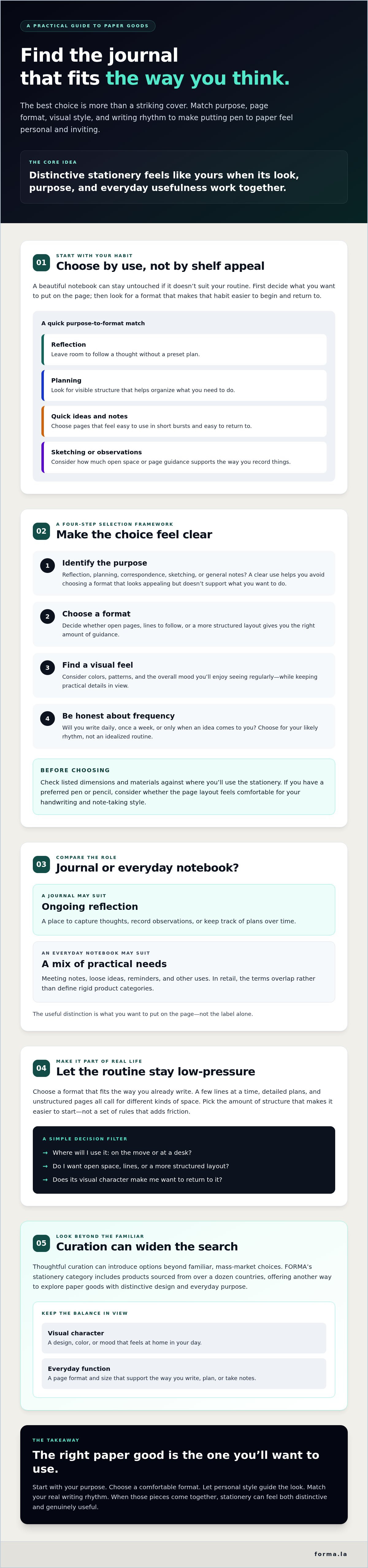
Start with your routine, not the cover. First, decide what you need your journal to help you do. That answer makes it easier to choose paper goods that feel distinctive and earn a place in everyday life. Use this four-step framework:
- 1. Identify the purpose. Are you making space for reflection, planning, correspondence, sketching, or general notes? A clear use helps you avoid choosing a format that looks appealing but doesn’t support what you want to do.
- 2. Choose a format. Decide whether you prefer open pages, lines to follow, or a more structured layout. Pick the amount of guidance that makes it easier to begin.
- 3. Find a visual feel. Consider the colors, patterns, and overall mood you’ll enjoy seeing regularly. Let personal style guide you while keeping practical details in view.
- 4. Be honest about frequency. Will you write daily, once a week, or only when an idea comes to you? Choose something that suits your likely rhythm rather than an idealized routine.
Which journal format suits your writing purpose?
For reflection, you may want room to follow a thought without a preset plan. Planning often benefits from visible structure, while capturing ideas may call for pages that are easy to use in quick bursts. For observations or ongoing notes, choose a format you can return to and scan. Lined, blank, and structured pages are common examples, not a guarantee of any specific shop’s inventory. Choose the format that removes friction instead of adding rules.
Writing tools matter, too. If you usually reach for a particular pen or pencil, consider whether the page layout feels comfortable for your handwriting and note-taking style. Check product descriptions for relevant details instead of assuming every journal will suit every tool.
How should you balance design and everyday function?
Picture where you’ll use your stationery. A journal that travels with you should feel manageable to carry; one kept at a desk can suit the way you like to write there. Page structure affects how easily you can plan, sketch, or leave thoughts unorganized. Before buying, check listed dimensions and materials against your practical needs.
An appealing design can draw you in, but your habits determine whether you’ll keep reaching for it. FORMA’s curated stationery selection is one place to browse as you decide what you want. If journaling is part of a personal reflection practice, the University of Rochester Medical Center also shares information on Journaling for Emotional Wellness. Choose paper goods that feel inviting, while keeping expectations grounded in your own needs and experience.
Unique Journals vs. Everyday Stationery: What Should You Compare?
A journal and everyday stationery can both hold your thoughts, but they often serve different rhythms. A journal is commonly one place for recurring personal writing or organized notes. Stationery can be more flexible, supporting quick reminders, correspondence, or changing tasks. The labels aren’t strict, so compare what each item helps you do rather than relying on its name.
Use these questions to weigh the options:
| What to compare | Journal | Everyday stationery |
|---|---|---|
| Purpose | Ongoing reflection, plans, observations, or records | Notes, messages, correspondence, or short-term organization |
| Frequency of use | Useful if you want a place to return to regularly | Useful when writing needs come up as part of varied tasks |
| Preferred structure | A consistent format can keep related entries together | Separate sheets or pieces can suit one-off, changing needs |
| Portability | Consider whether you’ll carry it or keep it in one place | Think about where you’ll store it and how easily you can reach it |
When is a dedicated journal more useful than loose stationery?
A dedicated journal gives ongoing entries or related notes a shared home. That can make it easier to revisit what you’ve written, though it won’t automatically create a writing habit. Loose stationery offers flexibility: use a page for a single message or reminder, then adapt as your needs change. Neither option is inherently better. Choose based on whether you prefer continuity or the freedom to use separate pieces.
Is distinctive stationery practical enough for regular use?
Yes, when its design and format fit a real task. Visual appeal can make an item enjoyable to use, but consider practical details too: does its size suit the place you’ll use it, does the layout work for your notes, and can you reach it when needed? With unique journals and stationery, usefulness comes from the match between character and function, not decoration alone.
Start with one piece that meets a current need, such as a journal for recurring entries or stationery for messages and quick notes. You’ll learn what works before committing to an imagined routine. A thoughtful choice should feel inviting and make sense in the life you already have.
How to Make Journaling and Stationery Part of Your Routine
A writing habit doesn’t need a perfect schedule or a beautifully filled page. A few useful lines can be enough to make a journal part of your day. Keep the start simple: choose a purpose, put your journal and writing tool within reach, then begin with a brief entry.
- Choose a purpose. Decide whether you want to capture an idea, note a plan, record an observation, or write a personal reflection.
- Make it easy to begin. Leave your stationery where you’re likely to use it, such as near a comfortable spot or alongside something you already reach for.
- Write a little. Start with a sentence, a question, or a short list. Stop when you’ve said what you wanted to say.
How can beginners start journaling without feeling overwhelmed?
Begin with one small prompt: “What stood out today?” “What do I need to remember?” or “What idea do I want to keep?” You can write after a daily transition, such as finishing work or settling in at home, or open your journal when a thought arises. There’s no need to keep a daily streak. Let the practice fit your life instead of turning it into another obligation.
Leave room for imperfect pages. A journal doesn’t need to read like an essay or look arranged; crossed-out words and brief notes are part of writing for yourself. The goal is to make a place for your thoughts, not to perform for an imagined reader.
How can stationery make a writing space feel personal?
Give your journal and writing tools a visible, convenient home. Choose a spot that feels comfortable and calm enough for a few minutes of attention. You don’t need special supplies or a dedicated desk. A familiar chair, a clear corner of a table, or another place you naturally pause can work just as well.
Small rituals can help mark the moment: sit down after a transition, take a breath, and write one line before moving on. If you’re exploring intentional everyday practices, FORMA’s guide to modern ritual supplies offers a related perspective.
Make the routine yours. Some days may call for a longer entry; other times, a reminder or single observation is enough. If you’re ready to find paper goods for your writing moments, explore FORMA’s stationery.
Explore Unique Journals and Stationery Through Thoughtful Curation
Once you know what you want your paper goods to do, the search can become less about scrolling through lookalikes and more about noticing what feels right. Thoughtful curation offers another way to discover: it brings together selected finds that may sit outside familiar, mass-market options. Still, a curated assortment can’t decide what suits you. Your purpose and preferences remain the best guide.
What can curation add to stationery discovery?
A considered assortment can make browsing more focused and introduce paper goods you might not have found in a routine search. FORMA curates products sourced from over a dozen countries and offers a stationery category. These details describe the breadth of the boutique’s curation, not the origin, materials, or makers of any particular stationery item. For a closer look at the thinking behind the shop, read the guide to FORMA’s curated lifestyle shop.
The value of discovery is personal. A piece doesn’t need to be rare or elaborate to feel distinctive to you. It might simply suit the notes you take, the messages you like to send, or the way you make room for ideas. Let curiosity open the door, then check practical details before deciding.
How can you choose a piece you will genuinely use?
Pause before choosing and ask what job you want the item to do. Will it support recurring writing, help you keep notes together, or give you a place for correspondence? Consider your preferred format and where the item will fit into your routine. Then review the current product description for details that matter to your decision. Don’t assume a format or feature unless it’s clearly stated.
The aim isn’t to assemble a perfect stationery setup. It’s to find one piece that feels inviting and fits a real moment in your day. A small, considered choice can be more useful than buying for a routine you hope to have someday. Explore FORMA when you’re ready to see what speaks to your way of writing.
Choose Paper Goods That Make You Want to Begin
The best paper companion isn’t necessarily the most elaborate. It’s the one that fits your purpose, feels personal, and makes writing or organizing easier to return to. Before choosing, consider what you’ll use it for, which format feels natural, and where it will fit into your routine. A short, occasional entry can be just as meaningful as a full page.
That’s the spirit behind finding unique journals and stationery: look beyond first impressions and choose details that connect visual appeal with everyday use. Thoughtful curation can open up possibilities, while your own habits help you decide what belongs in your life. FORMA curates products sourced from over a dozen countries and offers stationery through its online boutique.
Ready to browse with your routine in mind? Explore FORMA’s curated stationery and lifestyle finds, and see what catches your eye. Choose a piece that feels inviting, then let your own words give it meaning.
Frequently Asked Questions
What makes a journal or stationery item unique?
A journal or stationery item feels unique when its design, purpose, and everyday usefulness fit the person using it. A distinctive cover can catch attention, but personal value often comes from details such as a layout that suits your notes or a format that supports your writing habits. The best choice needn’t be rare or elaborate. It should invite you to use it and express something of your own style.
How do I choose a journal I will actually use?
Choose unique journals and stationery by starting with a real need, such as collecting ideas, reflecting, planning, or keeping notes. Then consider how often you’ll write, where you’ll use the journal, and which page format feels comfortable. If you prefer to write on the move, portability may matter; if it will stay at home, other details may take priority. Choose for your usual routine, not an idealized one.
What is the difference between a journal and a notebook?
A journal often suggests a place for recurring personal writing, such as reflections, observations, or plans. A notebook is a broader term that can cover notes, ideas, reminders, and records. In everyday retail use, the terms overlap, so they don’t define strict product categories. Look at the intended use and page structure instead of relying on the label alone. Either can serve different purposes depending on how you use it.
Are lined or blank pages better for journaling?
Neither page style is universally better; choose based on what makes writing feel easy for you. Lined pages can help keep written entries aligned and may suit longer reflections or notes. Blank pages offer more freedom for sketches, diagrams, lists, or writing that moves in different directions. If you’re unsure, think about what you tend to put on paper. The right layout supports your ideas without making the page feel restrictive.
Can stationery help me build a journaling habit?
Stationery can make journaling easier to begin when you keep it within reach and connect it to a moment that already exists in your day. After a transition, for example, write one thought, question, or reminder. Keep entries brief and skip days without treating that as failure. A journal can invite you to write, but it can’t guarantee a habit. Let the practice stay flexible and personal rather than turning it into a performance.
How do I choose stationery as a thoughtful gift?
Choose stationery with the recipient’s habits in mind. Consider whether they enjoy writing reflections, keeping plans, sending handwritten messages, sketching, or making quick notes. If you’re unsure, a format suited to several everyday uses may be more comfortable than one designed for a narrow purpose. Pay attention to the recipient’s visual preferences, too, but don’t assume an attractive design alone will make the gift useful.
What should I look for when buying journals online?
Read the product description carefully and check details that affect everyday use, such as dimensions, page layout, and listed materials. Product images can help you assess the visual style, but confirm practical information in the written description instead of guessing from appearance. Check current availability and review the retailer’s shipping and return information before ordering. If a detail you need isn’t listed, look for clarification before deciding whether the journal suits your routine.