


What if the feeling of a place could begin with a page, not a plane ticket? Global inspired stationery can bring a sense of discovery to everyday notes, lists, and letters. But a worldly look alone doesn’t tell you where a design comes from. It’s reasonable to want paper goods that feel more personal than mass-produced prints, along with clear, honest descriptions of their influences and origins.
The details make the difference. A distinctive palette, motif, layout, or paper texture may catch your eye. Product information can help you understand what’s known about the maker and the design’s inspiration. In this guide, you’ll learn how to notice those details, choose stationery that suits your taste and intended use, and bring it into daily life without assuming every design has a specific cultural origin.
We’ll also look at how to move beyond vague “global” language and make a more informed choice. FORMA curates lifestyle goods sourced from over a dozen countries, including stationery, but the origin and influences of individual paper goods aren’t specified across the category. Browse with curiosity, and let the pieces that genuinely appeal to you earn a place on your desk.
Key Takeaways
- Global inspired stationery describes a design sensibility, not proof of where an item was made. Check product details before drawing conclusions about its origins.
- Notice visible cues such as color, motifs, layout, and texture to identify what makes a design distinctive.
- Match stationery to its purpose by weighing format and writing comfort alongside its visual character.
- Give a chosen piece a place in your routine, whether for lists, reflective writing, handwritten notes, or thoughtful gift messages.
- FORMA’s stationery is part of a wider lifestyle selection curated from over a dozen countries, though individual stationery origins may vary or be unspecified.
What Makes Global Inspired Stationery Feel Distinctive?
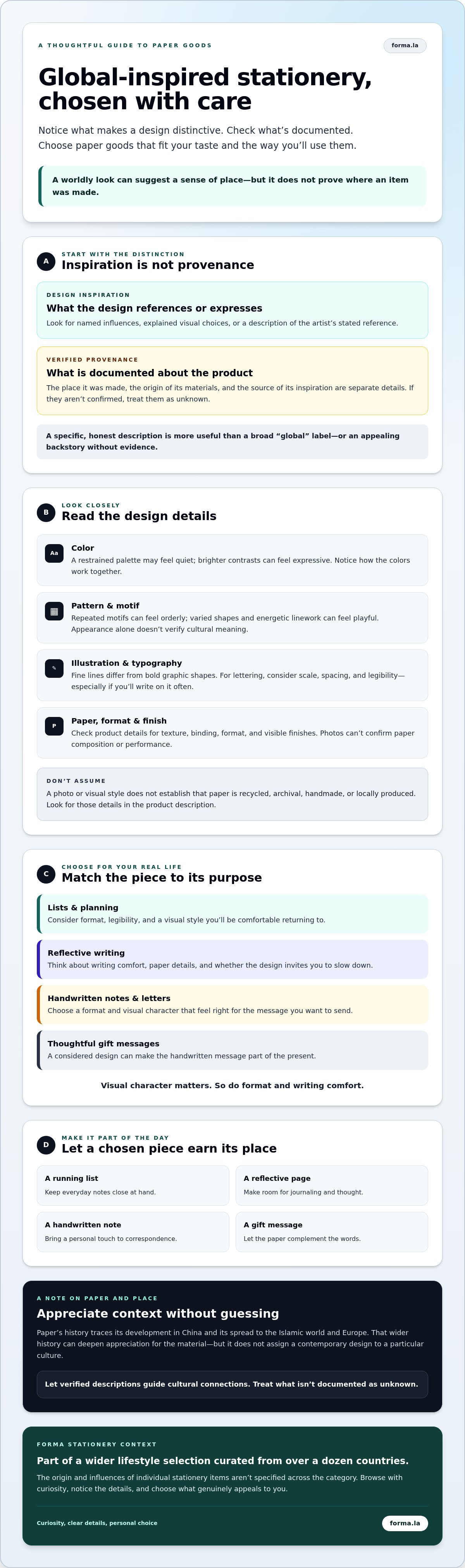
Global inspired stationery is paper goods shaped by design references, visual details, or storytelling connected to varied places. The phrase describes a broad design sensibility, not a guarantee of where an item was made. A notebook might evoke a sense of place through its colors or composition, while its manufacturing location and material sources remain separate details to verify.
That distinction doesn’t take away from the pleasure of choosing expressive paper goods. A distinctive page can make correspondence feel more considered, add personality to a planner, or encourage you to slow down while journaling. Stationery can also make a gift message part of the present. Its appeal is both visual and personal: a small everyday object can reflect what you notice, collect, and want to remember.
How Can Paper Goods Express a Sense of Place?
Look closely at the design choices. Color, pattern, illustration, typography, layout, and material all contribute to a paper good’s character. A restrained palette may feel quiet, while layered graphics may feel lively. A product description that names an artist’s references or explains a specific visual choice gives you more to consider than a broad label alone.
Paper itself has a long history of movement and exchange. The history of paper traces its development in China and its spread to the Islamic world and Europe, offering context for the material behind stationery across many traditions. That history can deepen your appreciation without implying that a contemporary design belongs to one culture. Let verified descriptions guide cultural connections, rather than assigning meaning to a motif based on appearance alone.
Global Inspiration Versus a Generic “Worldly” Label
Specific language helps you understand what you’re seeing. “Inspired by global design” leaves questions open. A useful description might identify the palette, describe the illustration, or name an artist’s stated reference. It should distinguish that inspiration from where the paper was made or where its materials originated, since these details can differ.
Global inspiration describes a design’s references; verified provenance describes the documented origin of the product, its materials, or its making. If those origins aren’t confirmed, a thoughtful seller can say so instead of offering an appealing but unsupported backstory. As you browse, look for named influences and concrete product details, and treat anything unverified as unknown. This helps you choose a design you genuinely enjoy without mistaking atmosphere for evidence.
Explore the Design Details Behind Globally Inspired Stationery
A strong design doesn’t need a sweeping backstory to catch your eye. When evaluating global inspired stationery, focus first on what’s visible and described: how colors work together, whether patterns repeat, how illustrations are drawn, and what the listing says about the paper and finish. These details help you judge a piece on its own terms without guessing at cultural meaning or origin.
Patterns, Color, and Illustration
Contrast and repetition set a design’s rhythm. A small motif repeated across a page may feel orderly, while varied shapes and energetic linework can feel more playful. A limited palette often reads as restrained; brighter contrasts can make a design feel expressive. Illustration matters, too. Fine, delicate lines create a different mood from bold graphic shapes. These are ways to describe visual character, not proof of a design’s cultural source.
Think about where you’ll use the stationery. A quiet pattern may suit notes you’ll revisit often, while a more vivid design could make a gift message feel celebratory. The U.S. Library of Congress’s collection on the art of correspondence offers a glimpse of decorated envelopes as personal expression, shaped by their time and context.
Typography, Paper, and Finishing Details
Lettering can make a page feel formal or relaxed. Consider its scale, spacing, and legibility, especially if you plan to write on the stationery often. Product photos may show surface texture, binding, or visible finishes, but an image can’t confirm the paper’s composition or performance. Check the listing for those details rather than assuming the paper is recycled, archival, handmade, or locally produced.
Color, pattern, illustration, typography, paper texture, format, and visible finishing details are all cues you can evaluate before purchasing.
- In photos: Check whether the design repeats, how much contrast it uses, and which details are visible at close range.
- In descriptions: Look for stated dimensions, paper or material details, and named design references.
- When details are absent: Treat them as unknown, rather than filling in the story yourself.
Focus on the cues that matter most to you, whether that’s clear writing space, expressive artwork, or a tactile-looking surface. For another point of discovery, browse FORMA’s curated stationery as part of its wider lifestyle selection.
How to Choose Global Inspired Stationery That Feels Personal
The right choice balances visual appeal with how you’ll actually use it. Before selecting global inspired stationery, picture its place in your routine. Will it travel with you, stay open on a desk, or carry a message to someone else? Then compare format, writing comfort, and the product details confirmed in the listing.
Match the Stationery to Its Purpose
Use this framework to narrow your options. The formats below are examples of what to consider, not a claim that a particular format is available from any specific retailer.
| Intended use | Visual character | Format to consider | Details to check |
|---|---|---|---|
| Daily notes or lists | Easy to revisit, with decorative details that won’t crowd the page | A size and layout that fit your usual writing | Writing space, dimensions, and whether the pages suit brief entries |
| Correspondence | A design that feels personal to you and appropriate for the recipient | A format with room for the message you want to write | What is included, such as envelopes, only if the listing confirms it |
| Reflective writing | A mood you’ll enjoy returning to | A format that feels comfortable for longer writing sessions | Paper details and layout, where specified |
| Thoughtful gifting | A look that connects with the person or occasion | A format suited to the message or use you have in mind | Contents and presentation details stated in the listing |
Think about portability and frequency of use, too. A compact format may be easier to carry, while a larger page may suit longer writing. If you write by hand often, give the page layout and available paper information as much attention as the design. Photos can suggest texture, but they can’t tell you how a surface feels or how your pen will behave on it.
Read Product Descriptions with Care
Look for dimensions, materials, included components, and care details when provided. Keep four questions separate: What inspired the design? Who made the item? Where was it manufactured? What materials does it use? An answer to one doesn’t confirm the others. Clear attribution is useful, but imagery alone isn’t evidence of a particular cultural influence.
For ideas on the meaning and practice of written messages, explore FORMA’s guide to artisanal greeting cards. Then browse with your own criteria in mind, weighing practical comfort and fit alongside the design that first caught your attention.
Make Globally Inspired Stationery Part of Everyday Rituals
A beautiful paper good becomes more meaningful when it has a place in your day. You don’t need an elaborate routine. Choose one item, give it a simple purpose, and keep it somewhere you’re likely to use it. Connecting an object with an everyday action can make writing feel natural, rather than like another task to complete.
From a Beautiful Find to a Daily Practice
Start with one intention. Perhaps you want to remember small moments, keep track of errands, or send notes to people you care about. Choose stationery that suits that use, then set it within easy reach, beside your reading space, on your desk, or near wherever you plan your week.
- Choose one item. Pick a piece of global inspired stationery whose design you enjoy and whose format fits your intended use.
- Assign it a purpose. Use it for one repeatable activity, such as a short reflective entry, a daily list, or a handwritten note.
- Pair it with a cue. Write after your morning coffee, during a weekly planning moment, or when you settle in to read.
Keep the practice flexible. A few lines count, and so does writing only when you have something to say. If journaling isn’t your habit, a page for reminders or a note to a friend can be just as satisfying.
Choose a small notebook for thoughts you want to revisit, or a card for a message you want someone to keep. Let the intended use guide your choice, and let the design make the moment feel like yours.
Give Paper Goods with Intention
When choosing a gift, consider what the recipient enjoys and what the occasion calls for. A card with a visual mood they’d appreciate can make your message feel especially considered. A written note can also add a personal touch to a separate gift. Keep the words specific to your relationship, whether you’re marking a milestone, offering thanks, or simply letting someone know you’re thinking of them.
For more perspective on the thought behind a written message, see the guide to handwritten notes and artisanal greeting cards. When you’re ready to find a paper good for your own routine or a future gift, explore FORMA’s stationery selection as part of its wider lifestyle curation.
Discover FORMA’s Curated Stationery Selection
Stationery is one part of FORMA’s wider lifestyle selection. As an online boutique, FORMA curates products sourced from over a dozen countries, bringing together goods chosen for a considered, personal way of living. That broader sourcing context offers a point of discovery, but it doesn’t mean every stationery item has a confirmed international origin or a specific cultural influence.
A Curated Browse, Not a One-Style-Fits-All Edit
Curation is an invitation to explore, not a promise that every piece shares one look. Stationery sits alongside other lifestyle goods, so the right fit depends on what appeals to you and how you plan to use it. Check each individual listing for confirmed details about design, materials, maker, and origin. If a detail isn’t stated, treat it as unknown rather than filling in a story based on appearance alone.
FORMA’s wider approach to selecting goods is explored in FORMA’s guide to sourcing soulful treasures. It offers context for browsing a curated selection while keeping your attention on the details that matter to you.
Choose the Piece You Will Reach for Again
Before settling on a design, consider four questions: What will you use it for? Which visual details appeal to you? Does the format suit your routine? What does the listing actually confirm? This simple check helps you weigh a distinctive look alongside practical fit, whether you’re choosing stationery for personal notes, lists, correspondence, or another everyday purpose.
There’s no need to rush toward a particular aesthetic or assume that “global” means one thing. The most satisfying piece may be the one that feels natural in your hand, leaves room for the words you want to write, or makes an ordinary moment more considered. Browse at your own pace, read the individual product information, and let personal taste lead.
If you’re ready to look, explore FORMA’s curated stationery and see which paper goods feel right for your everyday life.
Choose Paper Goods That Feel Like Yours
Distinctive stationery earns its place through the details you notice and how it fits your life. Color, pattern, typography, format, and writing comfort can help you choose global inspired stationery that feels personal. A clear product description helps you distinguish design inspiration from confirmed information about the maker, materials, or origin.
Give your choice a purpose, too. A paper good that’s easy to reach for may become part of a note, a list, a quiet writing moment, or a message tucked into a gift. Small, repeatable uses let design meet daily life without turning writing into another obligation.
FORMA is an online boutique with a stationery category within its wider lifestyle selection. Its products are sourced from over a dozen countries, though the origin of each stationery item should be checked in its individual listing. Browse at your own pace, follow the details that resonate, and explore FORMA’s curated stationery for a piece that suits your taste and everyday rituals.
Frequently Asked Questions
What is global inspired stationery?
Global inspired stationery is a broad design description for paper goods that draw on visual ideas, storytelling, or creative influences connected with different places. The phrase alone doesn’t confirm where an item was made or identify a specific cultural source. Look for concrete design details, such as described colors or illustrations, and check product information for verified claims about materials, influences, makers, or origin.
How do I choose stationery that feels globally inspired?
Start with how you’ll use it, whether for notes, correspondence, journaling, lists, or a gift message. Then consider the colors, patterns, illustrations, lettering, and format that suit your taste. Check the listing for confirmed materials and dimensions, too. If it names a cultural influence or place of origin, look for clear supporting details rather than assuming a design reference also identifies where the item was made.
Can globally inspired stationery be used for everyday writing?
Yes. A design’s inspiration doesn’t limit how you use the stationery. Choose a format that fits your routine, whether you need space for quick notes, lists, letters, or reflective writing. Check the listing for size and material details when available, then keep the item somewhere convenient. A distinctive design can bring personal character to an everyday task while still letting the paper serve its practical purpose.
What should I look for in a stationery product description?
Look for practical information such as dimensions, materials, format, and included components, when provided. For stationery described as globally inspired, see whether the listing explains its visual reference or creative influence clearly. Inspiration, maker location, manufacturing location, and material origin are separate details. Don’t assume one confirms another. If an important product detail is missing or unclear, ask the retailer before making your choice.
Is globally inspired stationery always made in another country?
No. “Globally inspired” describes a design idea or influence, not necessarily where an item was manufactured. A stationery design may draw on visual references while being made elsewhere, and the phrase alone doesn’t verify its materials or cultural source. Read the individual product description for confirmed information. If the listing doesn’t specify an origin or influence, treat that detail as unknown rather than interpreting the style label as proof.
Where can I find curated stationery with distinctive designs?
Explore curated online boutiques and compare stationery by intended use, format, visual details, and available product information. FORMA is an online boutique with a stationery category as part of its wider lifestyle selection, and it curates products sourced from over a dozen countries. That sourcing context doesn’t confirm the origin of every stationery item, so check individual listings for details about each piece. To browse FORMA’s selection, explore its curated stationery.