


What if the stationery you’re most drawn to isn’t the piece you’ll reach for every day? A beautiful cover may catch your eye, but the best choice also suits the way you write, plan, or capture everyday thoughts. Start with what you want your paper goods to do, then compare formats and details.
Product descriptions don’t always answer practical questions at a glance. Size, layout, and intended use can determine whether a notebook, journal, or notepad fits your routine. Knowing which details to check makes it easier to sort through the options and find a piece that works for you.
This guide covers how to compare stationery by purpose, format, design, and product details, whether you’re choosing for yourself or looking for a distinctive gift. We’ll look at FORMA’s assortment, from notebooks, journals, and notepads to pencil sets and desk organization pieces, and consider what each format can bring to everyday writing and work.
Key Takeaways
- Start with the task you want your paper goods to support, then narrow your options by format.
- Compare confirmed specifications before deciding whether a piece suits your writing tools or creative use.
- Consider how bound pages, tear-away sheets, and desk accessories fit different habits and workspaces.
- Choose stationery for its practical details and for a design that makes you want to use it.
- Use product examples as inspiration, not rankings, and check current listings for details that matter to you.
How to Choose Stationery That Suits the Way You Work and Create
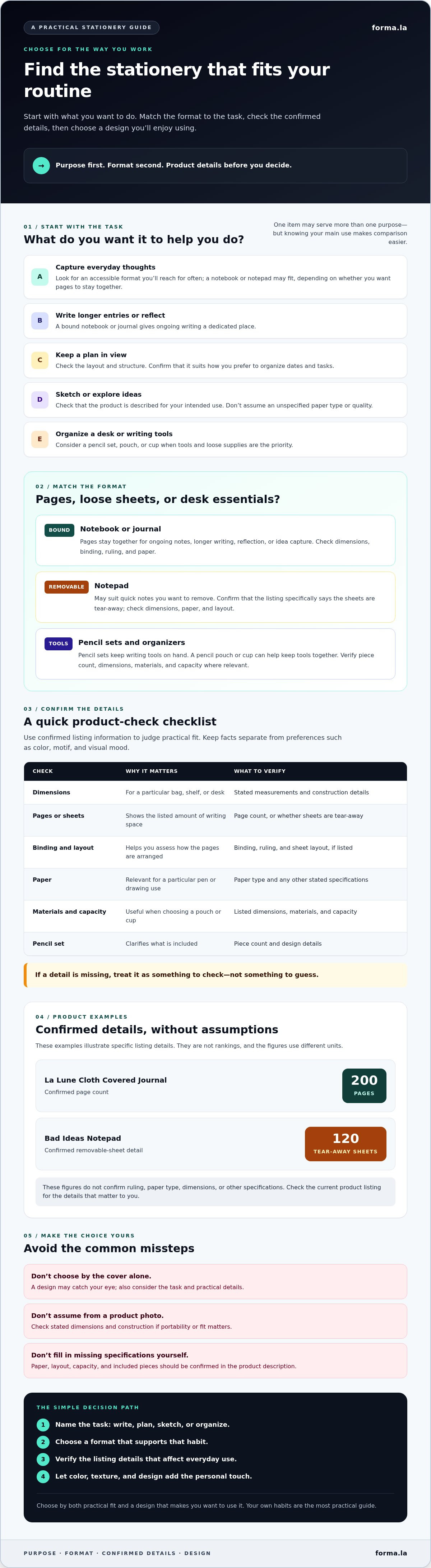
Start with the task you want the stationery to support. You might need a place to capture passing thoughts, write longer reflections, keep a plan in view, sketch, or organize a desk. Choose the format that suits the task, then consider which design you’ll enjoy using.
Different needs call for different features. Everyday notes benefit from easy access; journaling may call for a dedicated place for longer entries; planning depends on the layout and structure you prefer. For sketching, check that the product is described for your intended use rather than assuming any notebook will work. If your desk needs organizing, writing tools and holders may be more useful than another set of pages. One item may serve more than one purpose, but it helps to know what you’re buying it for.
A broad overview of Stationery can offer context on the category’s history and classifications. When choosing what to buy, your own habits are the more practical guide.
Start with what you want your stationery to do
Match the format to the moment you want it to support. Notebooks and journals give longer-form writing, reflection, or idea capture a dedicated home. A notepad may suit quick reminders or notes you want to remove, but confirm that the listing says the pages are tear-away. If writing tools are your priority, explore pencil sets. If loose supplies crowd your work surface, consider an organizer such as a pencil pouch or pencil cup. Decide on the purpose before comparing designs.
Planning and sketching deserve the same attention. Consider whether you need to organize dates and tasks or simply want room to explore ideas. A product description may not confirm the layout or paper qualities you’re looking for. Treat missing information as something to check, not something to guess.
Decide where and how often you will use it
Picture the item in its likely setting. Will it stay open on a desk, travel in a bag, or move between both? If portability matters, look for stated dimensions and construction details on the product listing. Without those specifics, a product photo alone may not tell you whether a notebook or organizer will fit your setup.
Then think about how often you’ll use it. A familiar routine, such as making daily notes, may call for an accessible format you’ll reach for often. Occasional creative work might suit a piece you bring out when inspiration strikes. Neither is more worthwhile. Choose something that matches how you actually work, with color, texture, and design adding a personal touch.
Which Stationery Features Matter Most When You Compare Products?
Once you know the purpose, compare the details that affect how a piece will work. Product type, stated dimensions, page count, binding, and portability can help distinguish similar-looking options, but rely only on details the listing confirms. Keep those facts separate from preferences such as color, motif, or visual mood. Both matter: specifications tell you what an item is, while design helps you decide whether you’re drawn to it.
Compare formats and confirmed features
A bound notebook or journal keeps pages together for ongoing notes, longer entries, or reflection. A tear-away notepad suits quick writing when you want to remove a page. Features vary by product. For example, FORMA’s supplied product information lists 200 pages for La Lune Cloth Covered Journal and 120 tear-away sheets for Bad Ideas Notepad. Those details don’t confirm the ruling, paper type, or other features, so check each listing for what you need.
| Format | Intended use | Confirmed features | Details to check |
|---|---|---|---|
| Journal | Ongoing writing or reflection | La Lune Cloth Covered Journal: 200 pages | Dimensions, binding, ruling, paper |
| Notepad | Quick notes or removable pages | Bad Ideas Notepad: 120 tear-away sheets | Dimensions, paper, sheet layout |
| Pencil pouch or cup | Keeping writing tools together | Product type | Dimensions, material, capacity |
| Pencil set | Having writing tools on hand | Product type | Piece count and design details |
Check details that affect everyday use
Check dimensions if an item needs to fit a particular bag, shelf, or desk. Page count indicates how much writing space is offered, while a stated binding or closure can clarify how the item is put together. Don’t infer capacity or durability from a pencil pouch’s or cup’s appearance. Check listed dimensions and materials. For pencil sets, confirm the piece count and design details in the product description rather than assuming what’s included.
Paper deserves attention if you use a particular pen or plan to draw. Paper type and other specifications can affect your experience, but don’t assume compatibility based on appearance alone. Check whether the listing provides relevant paper details and guidance for your intended tools or creative use.
Use verified specifications to narrow your stationery choices, then let your aesthetic preferences guide the final selection. To compare formats for writing and desk organization, browse the FORMA stationery assortment and check current product listings for the details that matter to you.
Notebooks, Journals, and Desk Accessories: Which Stationery Format Fits?
Choosing between formats comes down to what you want close at hand. A notebook, journal, notepad, writing tool, and organizer each support a different part of a routine. One well-chosen piece may be enough. A combination can make sense if you write in one place, keep quick reminders elsewhere, and like your tools gathered on a desk. Let your habits determine what you need.
When a notebook or journal is the better fit
A notebook can be a flexible home for work notes, lists, and ideas that don’t need a specific theme. A journal may suit a personal writing practice, especially if you want a dedicated place to return to. These are useful distinctions, not strict rules. Some people prefer one notebook for everything; others keep separate books for different kinds of writing.
Design can make a choice feel personal. The Navy Crane Notebook and Golden Mushroom Notebook are examples to consider if their designs catch your eye. The Awakening Embroidered Journal is described as having an embroidered cover. Those details can guide your aesthetic preference, but a product name or cover description doesn’t confirm dimensions, paper, ruling, or construction. Check the listing for the specifications that matter to you.
When a notepad or writing accessory makes more sense
A notepad may work well for reminders or notes you want to remove and share, provided its listing confirms tear-away pages. For writing tools, think about where they’ll live. A pencil pouch keeps supplies together in a container you can move between settings; a pencil cup gathers tools in one spot on a desk. The Mermaid Pencil Cup is an option to explore, but check its stated dimensions and materials to see whether it suits your setup.
The Celestial Heavens Pencil Set is described as a six-piece set. Treat that count as a detail specific to this product, not an assumption about other sets. Check the listing for any further information you need about its contents or design.
Try a simple test: identify the item you’d reach for most often, then decide whether another format solves a separate need. A notebook may suit a focused writing habit. A notebook paired with a notepad or desk accessory may better support different tasks, as long as each piece has a clear role. Choose the format and combination that make your routine easier to return to.
FORMA Stationery Picks: Match Distinctive Designs to Your Needs
A product name or striking cover can catch your attention, but the most useful choice fits your routine as well as your taste. These FORMA examples offer different visual details and formats to consider. They aren’t a ranking or a promise that one piece will suit everyone. Use the descriptions to identify what appeals to you, then check the current listing for any practical specifications you need.
For a distinctive notebook or journal
If a distinctive cover makes you more inclined to pick up a notebook, the Golden Mushroom Notebook has a gold-embossed mushroom motif and a sturdy classic cover, according to its supplied description. It may appeal if you want a familiar notebook format with a decorative detail.
For a journal with a celestial mood, La Lune Cloth Covered Journal has a moon-themed fabric cover and 200 pages. That page count is a confirmed detail, but it doesn’t tell you the journal’s dimensions, ruling, or paper type. Mineralogy offers another tactile detail: its supplied description notes a smooth sueded cover. Consider which cover you’d enjoy returning to, then look for other listing details that matter to your writing practice.
For notes, writing tools, and a more organized desk
If you prefer loose pages for quick thoughts or reminders, Bad Ideas Notepad is described as compact and has 120 tear-away sheets. It may be worth exploring if removable pages match your note-taking habit. Confirm the current listing’s other specifications before deciding how it will fit your desk or bag.
For keeping supplies together, the Navy Mushroom Pencil Pouch is described as navy canvas with a gold mushroom pattern. If you’d rather gather writing tools on a desk, the Mermaid Pencil Cup is described as powder-coated steel. These offer different approaches to organization: one is a pouch, the other a cup. Check each listing for dimensions and any additional construction details before choosing based on fit or intended placement.
A considered mix might pair a journal for longer writing with a notepad for reminders, or combine a notebook with a desk accessory if your tools need a home. You don’t need to choose a complete set. Start with the format you’ll use, then let a motif, cover, or material detail guide your preference. Explore FORMA’s stationery collection to compare the current selection and product descriptions.
Avoid Common Stationery Buying Mistakes and Choose with Confidence
A striking cover can make a product memorable, but appearance alone won’t tell you whether it suits your routine. A notebook title doesn’t confirm its size or paper, and a photograph may not show how an item is constructed. Separate the details you can verify from the qualities that come down to personal taste.
It’s also easy to collect several appealing pieces without knowing how you’ll use them. Start with a real need, then add another format only if it serves a different part of your day. A journal for regular writing and a notepad for removable reminders have distinct roles; two similar notebooks may not.
A simple checklist before you choose
Pause on each product listing and ask:
- What’s the task? Name the need: journaling, quick notes, planning, creative writing, or desk organization.
- What details are confirmed? Check stated dimensions, materials, page or sheet count, binding, and other relevant specifications. Don’t infer them from the product title or photos.
- Where will it live? Consider whether it will stay on your desk, travel in a bag, or move between both. Verify dimensions if fit matters.
- How often will you use it? A piece for a daily habit may call for a different format than one you’ll reach for occasionally.
- What design feels right? Let color, motif, and visual mood help you choose among options that already meet your practical needs.
Explore the collection when you are ready
Your best-fit format should make sense for the task, setting, and rhythm you have in mind. Before purchasing, confirm that the current product page includes the details you need, especially dimensions, materials, page count, and construction. If a specification isn’t stated, don’t assume it.
Browse the FORMA stationery collection at your own pace to compare notebooks, journals, notepads, writing tools, and desk accessories. Choose one piece that feels useful and inviting, or take time to explore. For another paper-goods perspective, look for the related article on the art of the handwritten note.
Choose Paper Goods You’ll Return To
The right stationery starts with the role you want it to play. Decide whether you need a place for journaling, quick notes, planning, or desk organization, then choose a format that fits your habits. Design can make a piece feel personal, while practical details help you assess whether it will work for your routine.
Before choosing, check current product listings for relevant specifications such as dimensions, materials, page or sheet count, and paper details. FORMA’s assortment includes notebooks, journals, notepads, pencil sets, pouches, and a pencil cup. Select product descriptions offer useful specifics, including La Lune Cloth Covered Journal’s 200 pages and Bad Ideas Notepad’s 120 tear-away sheets. Use those confirmed details to compare formats, not to assume that every similar item shares the same features.
Whether you’re looking for one dependable notebook or a few pieces with different roles, take your time comparing options. Explore FORMA’s stationery collection and review the current descriptions. A thoughtful choice can make everyday writing feel more inviting. Find the piece that feels right for you.
Frequently Asked Questions
What should I look for when buying stationery?
Start with the task, then check the product details that affect how you’ll use it. Consider whether you need a notebook for flexible notes, a journal for ongoing writing, a notepad for removable pages, or an accessory to organize your desk. Review stated dimensions, page or sheet count, materials, and construction on the current listing. Let design guide your preference, but don’t rely on appearance to answer practical questions.
What is the difference between a notebook, a journal, and a notepad?
A notebook is often a flexible place for notes, lists, or ideas, while a journal may be set aside for a personal or ongoing writing practice. A notepad is typically used for shorter notes, especially if its listing confirms tear-away pages. These distinctions aren’t strict: you might use any of them differently. Compare the format and confirmed features, then choose what feels natural for your habits.
How do I choose a journal for everyday writing?
Choose a journal you can comfortably return to, and consider where you’ll write. If it will travel with you, check its stated dimensions; if it will stay at home or on a desk, portability may matter less. Page count, ruling, paper type, and binding can also shape your experience, but confirm those details on the product page. A cover you enjoy can make the habit feel inviting, alongside a format that suits your routine.
Is a notepad better than a notebook for taking notes?
It depends on what you do with your notes. A notepad may suit quick reminders or information you want to detach, provided the listing confirms tear-away sheets. A notebook may be a better fit if you want notes to stay together for later reference. Consider whether you need to keep, share, or discard pages, then check the product description for format and page details before choosing.
What stationery makes a thoughtful gift?
A thoughtful gift reflects how the recipient likes to write, plan, or keep a desk. A journal may suit someone who enjoys personal writing; a notepad can work for quick notes if removable pages are confirmed. Pencil sets, pouches, and desk accessories offer other possibilities. Choose a distinctive design, but check the listing’s stated details so the format and practical features suit the recipient’s habits.
How can I tell whether a notebook’s paper suits my pens?
Check the product description for paper type or other paper details, then look for guidance that addresses the pens you plan to use. Don’t assume compatibility based on a notebook’s name, cover, or photographs. If the listing doesn’t provide enough information, seek clarification before relying on it for a particular pen or creative technique. Paper needs vary with writing tools and personal preference, so confirmed details matter more than general assumptions.
What stationery is useful for keeping a desk organized?
A pencil cup can keep writing tools gathered in one place, while a pencil pouch offers a way to store them together and may be easier to move between settings. A notepad can keep quick notes close at hand. Choose based on what tends to clutter your workspace, and check listed dimensions and materials before deciding whether an organizer fits your desk or holds what you need.