


What if the most meaningful meditation ritual began with less, not more? It’s natural to wonder which accessories are genuinely useful and whether a calm, consistent practice requires a carefully assembled collection. It doesn’t. Ritual accessories for meditation can offer a simple cue to pause, settle in, and return to a routine, but they’re there to support your practice, never to qualify it.
The right choice is personal. A cushion might make sitting more comfortable; a journal could help you mark a thought before you begin; a small object may simply make your space feel more inviting. None is essential, and no single item guarantees a particular outcome. What matters is whether it feels useful or meaningful to you.
In this guide, you’ll learn how to choose a few accessories with intention, shape a calm space, and create a repeatable ritual that still leaves room for change. We’ll explore practical ways to bring comfort, sensory detail, and personal expression into meditation without turning the practice into a shopping list. Start with what you already have, then let your routine reveal what, if anything, belongs beside you.
Key Takeaways
- Learn how simple objects can mark a transition into meditation while keeping attention and your chosen practice at the center.
- Explore ways crystals, apothecary supplies, ritual accessories, or stationery might support focus, atmosphere, reflection, or a sense of beginning.
- Choose ritual accessories for meditation by considering their purpose, care needs, sensory appeal, and whether you’ll use them regularly.
- Build a flexible routine around preparing your space, choosing one cue, meditating, and reflecting if you wish.
- Discover how thoughtful curation can make a practice feel personal without turning accessories into requirements.
What Are Meditation Ritual Accessories, and Do You Need Them?
Ritual accessories for meditation are optional objects you choose to mark the shift from everyday activity into your practice. They might be something you see, touch, or smell as you settle in, or simply an item that reminds you why you’ve made space to pause. The object itself isn’t the practice. Your posture, attention, and chosen way of meditating matter more than what’s arranged around you.
Meditation accessories are optional supports, not requirements. A consistent routine can begin with a familiar place and a simple cue, even if that cue is just sitting down and taking a few breaths. Over time, a repeated action or sensory detail may help your practice feel recognizable. It won’t guarantee calm, focus, healing, or spiritual progress, and it doesn’t need to.
Can meditation be meaningful without accessories?
Yes. You can sit quietly, follow the sensation of a few breaths, or return your attention to a chosen point without buying or arranging anything. If sitting on the floor feels uncomfortable, choose a stable position that works for your body. Meditative postures describes a range of sitting positions and supports, including cushions, benches, and chairs. A support can help you find a comfortable setup, but owning one isn’t a prerequisite for meditation.
Keep the entry simple. A practice can happen in a quiet corner or wherever you have a moment to pause. You don’t need a special room, a particular atmosphere, or a perfect routine before you begin. Let comfort and accessibility guide you.
What can an object add to a personal ritual?
An object can serve as a reminder to begin, a point of focus for your gaze or touch, or a symbol that carries personal meaning. A familiar texture, a visual detail, or a scent may become part of the sequence you repeat before sitting. These cues can make a routine feel more distinct, but their significance is personal, not proof of a universal or scientifically established effect.
For example, you might keep a crystal nearby because its shape or color invites your attention, or because it represents an intention you’ve chosen. Its meaning belongs to your practice; it shouldn’t be treated as a tool that guarantees an outcome. For ideas on using a crystal as an optional focal object, explore how to use crystals for meditation.
How Different Meditation Accessories Support a Personal Practice
An object earns a place in your meditation space through the role you give it. Choose accessories for the purpose you want them to serve, not because a ritual seems incomplete without them. One person may appreciate a visual focal point; another may prefer a notebook for reflection or a familiar sensory cue that marks the transition into practice.
These choices shape the atmosphere around meditation, but they don’t determine what meditation can do. The National Center for Complementary and Integrative Health shares an overview of the evidence on the health benefits of meditation. An accessory is simply a personal addition to the practice, not a guarantee of a particular result.
Objects for focus, reflection, and atmosphere
A crystal placed nearby may offer a visual detail to notice or a tactile point of attention. Stationery can give you a place to jot down an intention beforehand or a few reflections afterward. Neither needs to be elaborate: a brief note can be enough to help you approach your practice with purpose or remember what stood out.
Apothecary supplies or other ritual accessories may contribute a familiar sensory element, if that feels comfortable to you. Treat these as optional atmosphere, not as tools with universal meanings or assured effects. For related perspectives on ritual, explore modern ritual supplies and spiritual cleansing tools.
How to keep spiritual meaning personal and grounded
Meanings can come from memory, intention, appearance, or the simple pleasure of using an object. A crystal might remind you of a personal commitment; a notebook might make reflection feel natural. Someone else may see the same objects differently, and that’s fine. Let your associations guide you without assuming an item has the same significance for everyone or produces a specific outcome.
Practical fit matters, too. Consider whether an object feels comfortable to handle, needs care you’re willing to provide, or is likely to become part of your routine. A cushion or bell, for example, can be a general meditation accessory to consider for comfort or a start-and-stop cue, but these are not confirmed FORMA offerings.
FORMA curates crystals, apothecary supplies, stationery, and ritual accessories sourced from over a dozen countries. If you’re curious, you can explore these thoughtfully curated categories as possible additions, not a checklist. Start with the role you want an object to play, then choose only what feels useful or personally meaningful.
How to Choose Meditation Accessories Without Overbuying
The easiest way to avoid overbuying is to begin with your routine, not a shopping list. Meditation doesn’t require accessories, and a clear space with a comfortable place to sit may be enough. If you’re considering ritual accessories for meditation, first decide what you want an item to do. A purchase is more likely to feel worthwhile when its purpose is clear and it fits naturally into a practice you already enjoy.
Use this quick comparison to think through possible roles. These are ideas, not essentials or a prescribed set.
| Purpose | Possible accessory category | Practical consideration |
|---|---|---|
| Visual focus | A personally meaningful object, such as a crystal | Will you find it grounding to look at, or might it distract you? |
| Reflection | Stationery | Would writing before or after practice feel useful, and is it easy to keep nearby? |
| Atmosphere | Apothecary supplies or another sensory element | Consider scent preferences, sensitivities, and any care or setup involved. |
| Transition | A ritual accessory you already own | Can using it become a simple, repeatable cue to begin? |
Which accessory fits your meditation style?
Let the way you meditate guide the choice. If a visual point of focus sounds helpful, try one object with personal meaning rather than arranging several. If reflection is part of your practice, see whether a short note beforehand or afterward feels supportive. For atmosphere, consider whether scent or another sensory detail is genuinely pleasant for you. Skip it if you have sensitivities or would rather keep the space scent-free.
What should you consider before choosing?
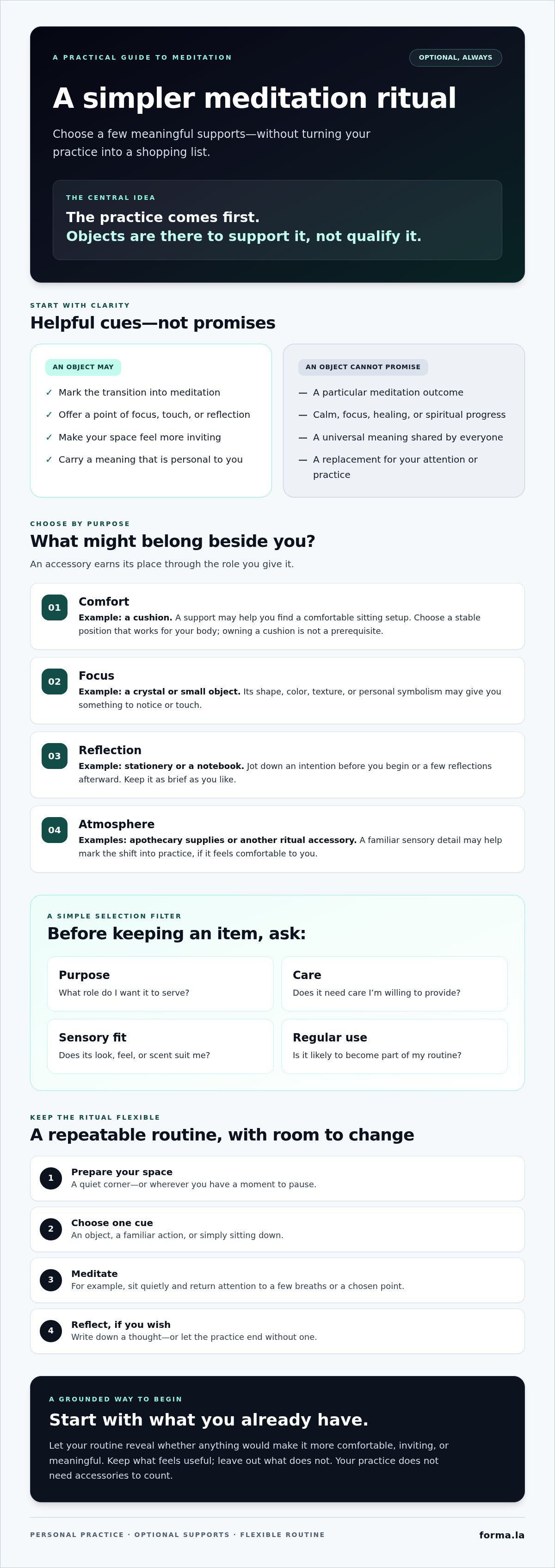
Before adding anything, ask yourself:
- Purpose: What specific role would this item play in my routine?
- Practicality: Where will I keep it, and does it need cleaning, refilling, or other care?
- Sensory fit: Do I enjoy its appearance, texture, or scent, or does it compete for my attention?
- Regular use: Can I picture reaching for it as part of an ordinary practice?
Then start with one thing you already own. A notebook, a familiar object, or simply the place where you sit can be enough to test whether a cue suits you. Give it a little time in your routine before deciding whether anything else would add value. If you rarely use it, let it go without treating that as a failure. A thoughtful practice can stay simple, and your setup can change as your preferences do.
How to Build a Simple Meditation Ritual with Accessories
A repeatable ritual doesn’t need a complicated setup or a fixed schedule. Think of it as a gentle sequence that helps you move from daily activity into meditation, then return to what comes next. The most useful ritual accessories for meditation are the ones that fit easily into that sequence. You can shorten it, skip a step, or change the objects as your needs shift.
A beginner-friendly ritual in four steps
- Prepare a place. Choose somewhere you can sit comfortably and reduce any avoidable distractions. It doesn’t need to be a dedicated meditation space.
- Choose one cue. Set out a single object that signals the beginning of your practice, or use a simple action you already associate with pausing. Keep the cue easy to reach and put away.
- Meditate in a familiar way. Follow an approach you know, such as noticing your breath or sitting quietly. Let the practice take the shape that suits the time and attention you have today.
- Close gently. Pause for a moment before moving on. If it feels useful, write a brief reflection or intention in your stationery; otherwise, simply put the object away.
The sequence can take as little or as much time as your day allows. There’s no required duration, and the cue doesn’t need to be elaborate. Its role is simply to help you recognize, “This is my moment to practice.”
Make the ritual sustainable, not elaborate
Keep setup and cleanup light enough that you can repeat them without turning preparation into another task. Store your chosen object where it’s easy to find, and notice over time whether it genuinely helps you settle into the routine or becomes something you have to manage. If it adds friction, leave it out or try a different cue.
Routines naturally change. You might meditate in a different place, choose another object, or return to a practice after a missed day. None of that means starting over. A ritual is a flexible framework, not a promise to follow the same steps perfectly.
If you’d like to consider an object for your own routine, you can explore FORMA ritual accessories alongside crystals, apothecary supplies, and stationery. Let your practice guide the choice, and keep only what feels personally meaningful and practical.
Explore Meditation Ritual Accessories That Reflect Your Practice
A meditation space can feel considered without being filled. One object that reminds you to pause, a notebook you reach for after sitting, or a sensory detail you genuinely enjoy may be more meaningful than a collection chosen because it seems expected. Let personal resonance and practical use lead. Accessories can complement your routine, but they’re never proof of commitment or a requirement for meditation.
A thoughtful edit for a personal meditation space
Think of your setup as a small edit. Choose only what has a place in your practice, whether that’s a visual reminder, a moment for reflection, or an atmosphere that feels inviting to you. Crystals, apothecary supplies, stationery, and ritual accessories can all be considered as optional additions. The value lies in how you choose to use them, not in how many you gather.
If crystals are part of what you’re considering, explore this crystal meditation guidance for ideas on incorporating one as a personal focal object. A crystal’s meaning can be individual; it doesn’t need to carry a universal significance or promise a particular effect.
FORMA is an online boutique curating lifestyle goods sourced from over a dozen countries, including crystals, apothecary supplies, stationery, and ritual accessories. That broad curation offers room to explore different forms of personal expression, without suggesting that any specific item is essential or that every item has the same origin.
Choose what feels useful, then let the ritual evolve
Your preferences may shift as your meditation practice changes. An object that once felt like a helpful cue might become unnecessary, or you may discover that a simple written reflection suits you better. Let your space change with you. Keeping or setting aside an accessory is a matter of fit, not a measure of how seriously you meditate.
As you browse, return to a simple question: does this feel personally meaningful, and can I imagine using it? If the answer is yes, it may have a place in your ritual. If not, there’s no need to add it. Explore at your own pace and choose only what resonates. Explore FORMA’s ritual accessories.
Let Your Practice Take Its Own Shape
A meaningful meditation routine doesn’t depend on a perfectly styled space or a collection of objects. The most useful ritual accessories for meditation are the ones that suit your intentions, feel practical to use, and make returning to your practice feel inviting. Begin with what you have, keep your setup simple, and let your preferences change over time.
If you feel drawn to add something, choose with care rather than obligation. FORMA is an online boutique curating lifestyle goods sourced from over a dozen countries, including ritual accessories, crystals, apothecary supplies, and stationery. These categories offer different ways to personalize a practice, but none is a requirement.
Take your time exploring, and trust your own sense of what belongs in your space. Explore FORMA’s curated ritual accessories and discover an option that feels right for you, or continue with nothing more than a moment to pause. Your practice can begin wherever you are.
Frequently Asked Questions
Do you need accessories to meditate?
No, you can meditate without buying or arranging any accessories. Sitting comfortably and paying attention to a few breaths is a complete place to begin. If you already have a familiar spot, you can use it as your practice space. Consider an accessory only if it serves a practical purpose, such as making sitting more comfortable or giving you a simple reminder to pause.
What accessories are commonly used for meditation?
People may use cushions, benches, or chairs for sitting support, along with objects such as a bell or timer to mark the start or end of a session. A notebook can hold intentions or reflections, while a crystal or another meaningful object may provide a visual focus. These are general examples, not a required set, and the right choice depends on your comfort and preferred way to meditate.
Can crystals help you meditate?
A crystal may serve as a visual or tactile focal object if you find it personally meaningful. You could place it nearby and notice its shape or color as you settle into practice. There’s no need to assign it a universal meaning or expect it to produce a specific effect. Consider it an optional part of your ritual, not a substitute for the meditation practice itself.
How do you create a simple meditation ritual at home?
Choose a comfortable place, reduce distractions you can control, and decide how you’ll begin, such as sitting down and taking a few attentive breaths. Add one optional cue if it feels useful, then follow a meditation approach you’re familiar with. End with a brief pause or reflection if you wish. Keep the sequence easy to adapt to your day, rather than tying it to a fixed duration.
What should you put in a meditation space?
Start with what helps you sit comfortably and focus your attention. Your space might need nothing beyond a clear place to sit. If useful, add one item such as a notebook for reflection or a meaningful object as a visual cue. Keep scent out if it bothers you or others nearby. Leave anything distracting, difficult to care for, or unnecessary outside the space.
Are meditation accessories worth buying?
They may be worth buying if you have a clear purpose for an item and expect to use it regularly. Before choosing, consider its practical care, storage, and whether its sensory qualities suit you. Try an object you already own first, such as a notebook or small keepsake. If it doesn’t support your routine, you haven’t failed; meditation can continue without it.