


In a world saturated with fleeting trends and mass-produced accessories, the most profound statement you can make isn't about what's new, but what's eternal. You've likely felt the fatigue of jewelry that lacks a story, pieces that look striking on a screen but feel hollow against your skin. It's often a struggle to find that perfect balance between a bold aesthetic and a piece that actually resonates with your spirit. Finding authentic lapis lazuli jewelry that hasn't been compromised by synthetic dyes or factory-line shortcuts can feel like a daunting search for a rare treasure.
We believe your wardrobe should be a curated reflection of your inner landscape. This guide will help you discover why this celestial blue stone is the ultimate essential for an intentional life in 2026. We'll explore the rich history and spiritual depth of this "Stone of Truth," while providing practical tips to ensure you're investing in genuine quality. From understanding its global origins to mastering the art of layering deep blue stones with your favorite essential rings and necklaces, you're about to learn how to weave ancient wisdom into a modern, soulful style.
Key Takeaways
- Understand the geological essence of lapis lazuli as a metamorphic rock and why its lazurite-rich blue has remained a symbol of power for millennia.
- Journey through time to discover how ancient civilizations used these stones from the mines of Afghanistan in sacred rituals and royal adornments.
- Master the art of identifying high-quality lapis lazuli jewelry by learning to spot common imitations and understanding the Mohs hardness scale.
- Learn effortless styling techniques to integrate bold blue gemstones into your existing collection of essential rings and necklaces.
- Gain insight into the intentional process of sourcing unique, soulful treasures from artisans across more than a dozen countries.
The Celestial Origin: Defining Lapis Lazuli’s Timeless Blue Appeal
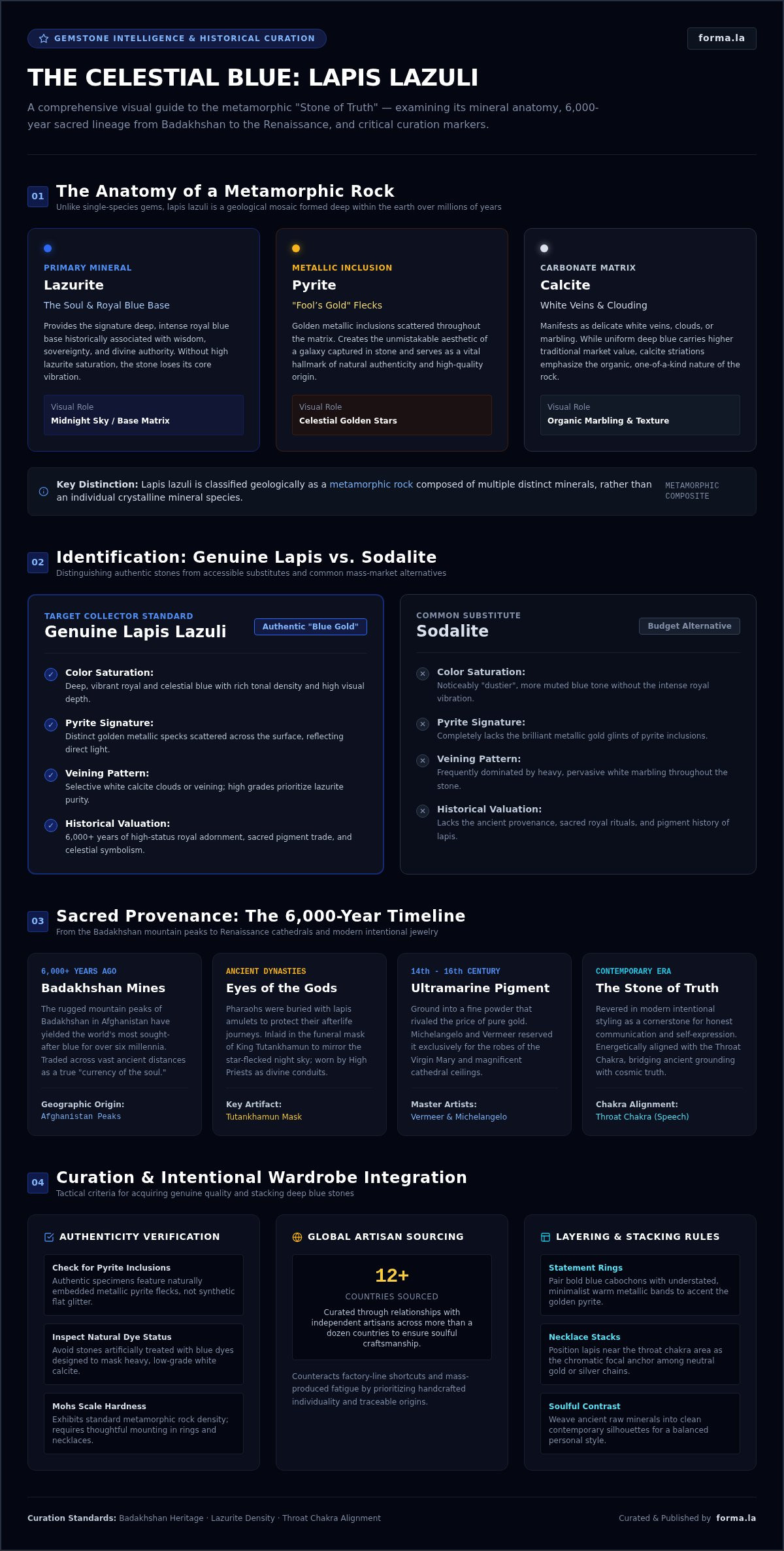
To understand the enduring allure of this stone, we must first look at what it actually is. Unlike many popular gemstones that are singular mineral species, lapis lazuli is a metamorphic rock. This distinction is vital for the discerning collector. It means every piece is a complex mosaic of geological history, formed deep within the earth over millions of years. Its iconic deep blue hue isn't just a surface-level aesthetic; it's a vibration that has captivated humanity for millennia. From the tombs of pharaohs to the palettes of Renaissance painters, this "blue gold" has always represented something beyond the mundane.
The visual depth of the stone often earns it the title of the "stone of the stars." This isn't just poetic phrasing. The presence of golden pyrite inclusions scattered against a midnight blue background creates the unmistakable appearance of a galaxy captured in stone. When you wear lapis lazuli jewelry, you're carrying a piece of that celestial energy, grounded by the weight of ancient earth. It's a bridge between the tangible world and the infinite, making it a cornerstone for any intentional, soulful wardrobe.
The Anatomy of a Gemstone: Lazurite, Pyrite, and Calcite
The character of each stone is defined by its specific mineral makeup. Lazurite is the heart of the rock, providing that intense royal blue base that we've come to associate with power and wisdom. Without a high concentration of lazurite, the stone loses its soul. Pyrite, often called "fool’s gold," adds the signature gold flecks. These aren't just decorative; they're a hallmark of authenticity and high-quality origin. White calcite can also appear as delicate veins or clouds. While a pure, deep blue is traditionally more valuable, these white inclusions can add a beautiful, marbled texture that highlights the stone's organic, one-of-a-kind nature.
Lapis Lazuli vs. Sodalite: Identifying the Difference
In your search for the perfect piece, you'll likely encounter sodalite. While beautiful in its own right, it's often used as a more accessible substitute for lapis. Sodalite typically has a "dustier," more muted blue and often features heavy white marbling without the brilliant gold of pyrite. Lapis lazuli remains the preferred choice for those seeking a deeper, more "royal" vibration. The presence of pyrite is the easiest way to distinguish the two; if you don't see those metallic golden glints, you're likely looking at sodalite. For a truly curated collection, the rich history and unmistakable fire of genuine lapis lazuli jewelry offer a level of significance that mass-market alternatives simply cannot replicate.
A Portal to the Past: The Spiritual History of the Blue Stone
The story starts in the rugged mountains of Afghanistan, specifically the Badakhshan mines. For over six thousand years, these peaks have yielded the world's most sought-after blue. It's a source that remains unparalleled for its depth and saturation. Long before it was a staple in modern lapis lazuli jewelry, it was a currency of the soul; a symbol of wisdom and truth traded across vast distances and revered by every major civilization that touched it.
In Ancient Egypt, the stone was more than an ornament; it was a bridge to the divine. Pharaohs were buried with lapis amulets to protect their journey into the afterlife. The funeral mask of Tutankhamun features striking inlays of the stone, chosen to mimic the star-flecked night sky. It represented the eyes of the gods, a physical manifestation of cosmic truth that commanded respect from all who beheld it. High priests also wore the stone to signify their status as intermediaries between the heavens and the earth.
By the time it reached the European Renaissance, its value rivaled gold. Ground into a fine powder, it became "ultramarine," the most expensive pigment available to masters like Vermeer and Michelangelo. This transition from raw rock to sacred paint allowed the celestial blue to adorn the robes of the Virgin Mary and the ceilings of cathedrals. Understanding how to identify high-quality lapis lazuli allows you to appreciate the same intensity of color that these artists risked everything to obtain. For centuries, it was the only way to capture the true depth of the sky on a canvas.
The Stone of Truth: Spiritual Meanings and Rituals
Modern seekers often turn to this stone for its alignment with the Throat Chakra. It's believed to facilitate honest communication and help the wearer find their authentic voice. Using lapis lazuli jewelry as a tool for self-reflection encourages a deeper look at one's own motivations. Consider these ritualistic uses for your collection:
- Wear it during difficult conversations to maintain a sense of calm and clarity.
- Place it on your desk to inspire creative breakthroughs and intellectual focus.
- Meditate with the stone to access deeper layers of intuition and inner wisdom.
Lapis lazuli is a sacred talisman designed to ignite intellectual expansion and clarity of thought. It serves as a reminder to speak your truth with quiet confidence.
From Pharaohs to Painters: A Legacy of Blue
The rarity of the stone in the ancient world meant it was reserved for those who walked the halls of power. Its journey along the Silk Road to European ateliers is a testament to human fascination with the extraordinary. When you choose a piece today, you're not just following a trend; you're connecting to a global lineage of seekers, artists, and royalty. It's an invitation to participate in a history that spans continents and centuries. You can begin your own journey of discovery by exploring our curated rituals and treasures.
The Curator’s Eye: How to Identify High-Quality Lapis Lazuli
Becoming a discerning collector requires more than just an appreciation for beauty; it demands an eye for authenticity. On the Mohs hardness scale, lapis lazuli sits between a 5 and 6. This means while it's sturdy enough for daily expression, it's softer than quartz or sapphire. Understanding this balance is the first step in curating a collection that lasts a lifetime. When selecting lapis lazuli jewelry, you'll often hear terms like "AAA grade." This refers to stones with an intense, uniform royal blue and a fine dusting of gold pyrite. Commercial grades, by contrast, often feature heavy white calcite patches or greyish tones, offering a more rustic but less "celestial" appeal.
The choice between a polished cabochon and a raw, organic cut depends on your personal ritual of style. Polished stones reveal the full depth of the lazurite, while raw cuts celebrate the stone's journey from the earth. Both have a place in a soulful wardrobe, but higher quality material is almost always reserved for smooth, polished finishes to showcase the clarity of the blue.
Spotting the Signs of Authentic Lapis
Authenticity is found in the details. Natural pyrite is hard to fake; look for tiny, irregular metallic grains that seem to grow out of the blue, rather than sitting on top. A common industry secret is the acetone test. A gentle wipe with a cotton swab dipped in acetone will reveal surface dyes on lower-quality or "reconstituted" stones. If the swab turns blue, the stone's color isn't natural. Beyond visual cues, trust your senses. Genuine lapis feels significantly heavier than plastic imitations and remains noticeably cold to the touch, even in a warm room.
Caring for Your Soulful Treasures
Protecting these treasures is a practice of mindfulness. Because of its porous nature and moderate hardness, you should never use ultrasonic cleaners or harsh chemicals. These can strip the stone of its natural luster or even cause it to crack. Store your pieces in soft pouches, away from harder gemstones like diamonds that might leave surface scratches. Finally, consider the spiritual maintenance of your stone. Cleansing your jewelry with selenite or the light of a full moon is a beautiful way to reset its energy and honor its celestial origins.
Styling the Sacred: Integrating Lapis into an Eclectic Jewelry Stack
Lapis lazuli is often viewed as a bold choice, yet its midnight hue functions remarkably well as a neutral. It anchors a look without overwhelming it, providing a steady base for more experimental pieces. When you are curating an eclectic jewelry collection, the goal is to find pieces that speak to one another across different eras and origins. Lapis lazuli jewelry bridges the gap between cool sterling silver and the warmth of gold vermeil effortlessly. Silver highlights the stone's icy blue depth, while gold draws out the fire of the pyrite inclusions, allowing you to mix metals with quiet confidence.
Pairing your jewelry with unique clothing pieces creates a cohesive, intentional vibe that feels both personal and polished. Imagine a deep blue pendant resting against raw silk or organic linen. The textures play off each other, suggesting a life lived with purpose and a deep appreciation for the handmade. This stone doesn't just sit on the skin; it interacts with the fabrics you choose, grounding your entire aesthetic in a sense of history.
Layering Necklaces and Stacking Rings
Achieving a balanced stack often comes down to the "Rule of Three." Try layering three necklaces of varying lengths: a short choker, a medium chain with a small charm, and a longer lapis lazuli jewelry piece as the anchor. This creates visual movement and depth. Don't be afraid to mix your stones. Deep lapis pairs beautifully with the ethereal glow of moonstone or the vibrant pop of turquoise. Mixing textures is equally vital. Combine a raw, unpolished stone pendant with sleek, polished essential rings—you can visit Jewellove to find high-quality pieces to complete your look—to create a look that feels discovered rather than simply purchased.
The true beauty of these pieces lies in their versatility. A simple lapis pendant adds a soulful touch to a minimalist bralette or a simple linen top, turning a casual moment into a personal ritual. For a more structured look, use bold lapis rings to anchor a flowy, boho-chic outfit or to add a pop of color to a sharp blazer. These stones transition seamlessly from your morning meditation rituals to evening gatherings with friends. They carry a steady energy that works in any setting, ensuring your style remains as intentional as your lifestyle. Explore our latest arrivals to find the perfect blue treasure for your daily ritual.
Discovering Rare Beauty: The FORMA Lapis Lazuli Curation
Finding a piece that resonates with your personal narrative is a journey of discovery. At FORMA, we've dedicated ourselves to acting as a bridge between global artisans and the modern seeker. Our search for the extraordinary has taken us to more than a dozen countries, allowing us to curate a selection that prioritizes rarity and emotional value over mass-market convenience. When you choose lapis lazuli jewelry from our collection, you aren't just buying an accessory; you're acquiring a soulful treasure that has been carefully selected for its unique character and history.
Because we work with natural stones, no two pieces are ever identical. The specific arrangement of golden pyrite and white calcite in your stone is a one-of-a-kind map of the earth's history. This inherent individuality is what makes these pieces so special. They aren't stamped out of a mold in a factory. They're organic, tactile, and deeply personal. We invite you to explore our eclectic selection of jewelry and ritual accessories to find the stone that mirrors your own inner landscape.
Artisan Craftsmanship and Global Sourcing
Choosing curated pieces over mass-produced items is an act of intentionality. It's a rejection of the "disposable" culture that often plagues the modern wardrobe. Every piece in our boutique is chosen with a specific intention, focusing on craftsmanship that honors the raw beauty of the materials. We believe in the power of a soulful discovery. It's that quiet, electric moment when a stone "speaks" to you, suggesting it belongs in your daily ritual. This connection is only possible when a piece has a story to tell, something mass-market items simply lack.
A Complete Lifestyle of Intentionality
Our curation extends far beyond the jewelry box. We view lapis lazuli jewelry as a vital component of a broader lifestyle rooted in self-care and mindfulness. It pairs beautifully with our apothecary offerings and ritual accessories, creating a cohesive environment for personal transformation. Whether you're layering a pendant with our timeless necklaces or anchoring your look with essential rings, these pieces are designed to transcend seasonal trends.
Owning a timeless treasure means you don't have to worry about fleeting fashions. Lapis has been a symbol of wisdom for thousands of years; its appeal is enduring. We invite you to join our community of discerning individuals who value authenticity and global discovery. By choosing pieces with history and heart, you're building a wardrobe that is as meaningful as it is beautiful.
Embracing the Eternal Blue in Your Daily Ritual
Your journey into the world of celestial blue shouldn't end with a simple purchase. It's an invitation to connect with a 6,000-year-old lineage of wisdom and truth. By understanding the geological soul of the stone and the art of identifying genuine quality, you're now equipped to choose lapis lazuli jewelry that transcends seasonal trends. Whether you're layering deep blue pendants with your favorite gold vermeil or anchoring a simple linen look with a bold ring, these pieces serve as daily reminders of your own intentional path.
At FORMA, we've traveled to over 12 countries to find these unique, one-of-a-kind treasures for your collection. We believe in the power of soulful discovery and the joy of finding a piece that feels like it was meant only for you. Explore the Curated Lapis Lazuli Jewelry Collection at FORMA and enjoy free shipping on our curated lifestyle goods. Step into a world where every accessory is a portal to a deeper sense of self; your next timeless treasure is waiting to be found.
Frequently Asked Questions
Can I wear lapis lazuli jewelry every day?
You can wear your pieces daily provided you take mindful precautions to protect the stone's surface. Since it ranks between a 5 and 6 on the Mohs scale, it's softer than quartz or diamonds. It's best to remove your rings before heavy lifting or using household cleaners. Storing your items in a soft pouch prevents scratches from harder gems. This mindful approach ensures your soulful treasures remain a vibrant part of your daily ritual.
How can I tell if my lapis lazuli is real or dyed?
Authentic stones typically feature irregular flecks of golden pyrite and varying depths of blue. You can test for artificial dyes by gently wiping a small area with a cotton swab dipped in acetone; if blue pigment transfers to the swab, the stone has been treated. Genuine lapis lazuli jewelry also feels noticeably cold to the touch and carries more weight than plastic or resin imitations frequently found in mass-market boutiques.
What is the spiritual meaning of wearing lapis lazuli?
Wearing this stone is traditionally associated with the activation of the Throat Chakra and the Third Eye. It's revered as a symbol of universal truth and inner wisdom, helping the wearer communicate with clarity and confidence. Many use it as a talisman for intellectual expansion and self-reflection. By integrating it into your daily wardrobe, you're inviting a sense of ancient protection and spiritual insight into your modern lifestyle rituals.
Does lapis lazuli tarnish or fade over time?
Natural lapis lazuli doesn't tarnish like metals, nor will its deep blue hue fade under normal light conditions. However, the stone's luster can become dull if exposed to acidic substances, perfumes, or excessive perspiration. If you notice significant color loss after cleaning, the stone likely contained synthetic dyes. High-quality, untreated stones maintain their celestial vibration and rich saturation indefinitely when they're handled with the respect and care they deserve.
What metals look best with lapis lazuli jewelry?
Both cool and warm metals complement the stone's complex character in different ways. Sterling silver provides a crisp, modern contrast that highlights the icy depth of the lazurite. Conversely, gold vermeil or solid gold draws out the sparkling warmth of the pyrite inclusions, creating a regal and timeless aesthetic. Mixing these metals within a single stack allows for a more eclectic, personal expression that feels curated rather than simply matched.
Is lapis lazuli considered a birthstone?
While turquoise is the modern birthstone for December, lapis lazuli is often celebrated as the traditional birthstone for that month. It's also frequently associated with the zodiac sign of Sagittarius. In some planetary traditions, it serves as an alternative stone for September. Regardless of your birth month, many seekers choose lapis lazuli jewelry based on an intuitive pull toward its specific energy and historical significance rather than adhering to traditional calendars.
How do I energetically cleanse my lapis lazuli jewelry?
You should avoid using water or salt for cleansing, as the stone's porous nature makes it susceptible to damage. Instead, use these gentle methods:
- Place your jewelry on a selenite charging plate overnight.
- Leave the stone in the light of a full moon.
- Pass the piece through the smoke of sacred herbs or incense.
What is the difference between lapis lazuli and lazurite?
The primary difference lies in their geological classification. Lapis lazuli is a metamorphic rock composed of several minerals, whereas lazurite is the specific mineral responsible for the stone's vivid blue color. A high-quality specimen typically contains at least 25 percent lazurite. Other components include golden pyrite and white calcite. Understanding this distinction helps you appreciate the complex, mosaic-like nature of the treasures you'll find during your global search for authentic pieces.