


A single piece of selenite crystal acts as more than just a decorative object. It is the master key to a high-vibe, intentional home. You likely recognize its pearlescent, moon-like glow, yet the nuances of its care often feel shrouded in mystery. It's easy to feel overwhelmed by conflicting names like Satin Spar or the fear of damaging such a delicate, ethereal stone. We believe that building a meaningful collection should feel like a soulful discovery, not a technical chore.
This guide is designed to strip away the complexity and focus on the connection between your space and your tools. You'll discover exactly how to harness this luminous mineral to cleanse your other crystals and elevate your daily rituals with quiet confidence. We'll explore the rich history of the stone, provide practical steps for its preservation, and offer aesthetic inspiration for placing these treasures throughout your home. By the end, you'll have a clear, curated path toward a more intentional and luminous way of living.
Key Takeaways
- Distinguish the unique textures between Satin Spar and True Selenite to choose pieces that resonate with your personal aesthetic.
- Master the art of using a selenite crystal as a natural charging station to cleanse and revitalize your other stones effortlessly.
- Learn how to create a protective "grid of light" within your home by placing towers and slabs in specific, high-traffic areas.
- Discover why water is the greatest threat to your stone and how to preserve its ethereal glow through mindful handling.
- Transform your workspace into a sanctuary by integrating these functional ritual tools into your daily creative flow.
The Luminous Essence: What is a Selenite Crystal?
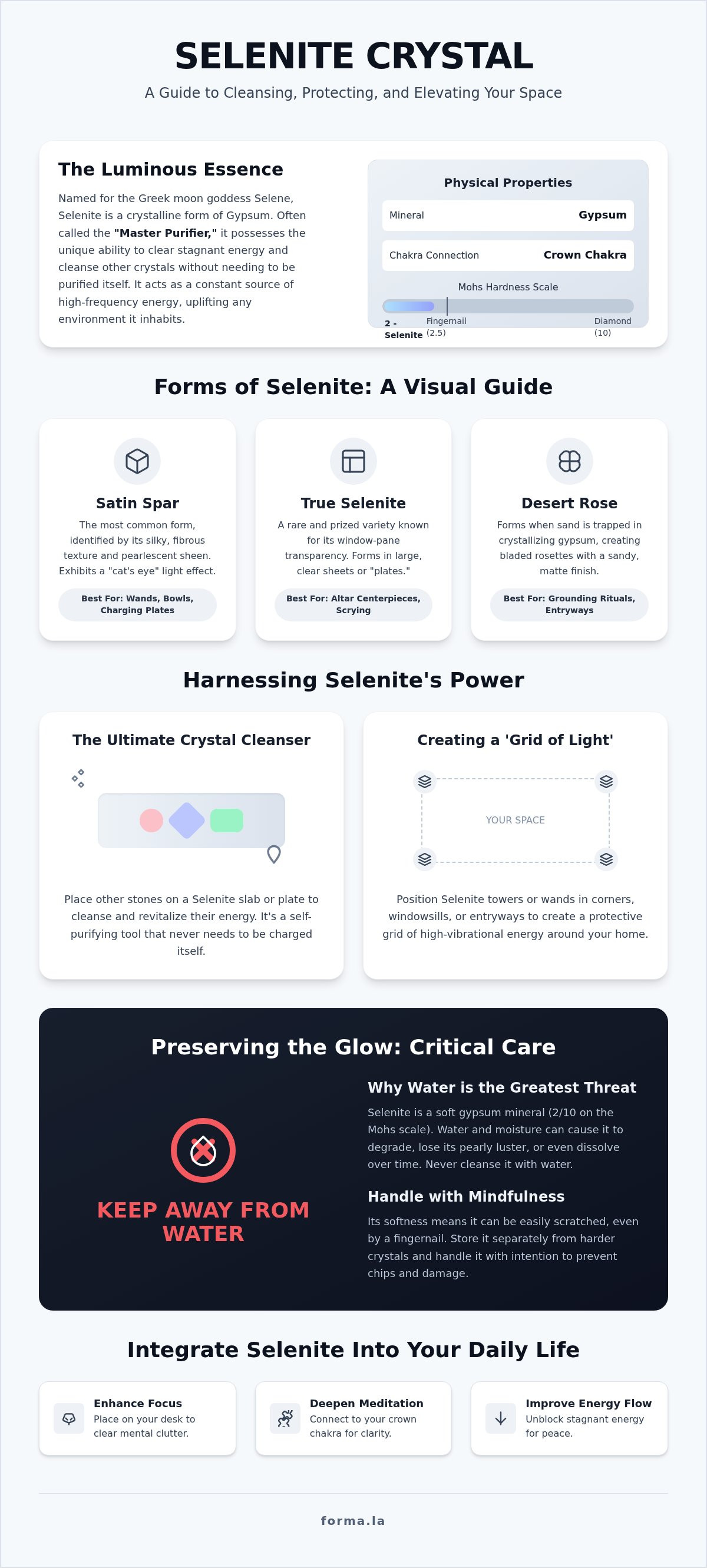
A selenite crystal is a rare bridge between the physical and the intangible. It isn't just a stone; it's a captured fragment of moonlight. Named for the Greek goddess Selene, this mineral embodies the soft, silvery glow of the lunar cycle. Collectors often call it the "Master Purifier" because it possesses the unique ability to clear stagnant energy without needing to be cleansed itself. Unlike most stones that absorb the vibrations around them, selenite acts as a perpetual motion machine of light, constantly radiating a high-frequency energy that uplifts any environment.
The Physicality of Light: Gypsum and Hardness
Technically, Selenite (gypsum) is a crystalline variety of the mineral gypsum, specifically calcium sulfate dihydrate. It's fascinating to realize that a selenite crystal forms in ancient evaporative basins, where saltwater slowly recedes and leaves behind these luminous treasures. On the Mohs scale of mineral hardness, it sits at a delicate 2. This means it's soft enough to be scratched by a fingernail, demanding a level of mindfulness during handling that mirrors the intentionality of our rituals. High-quality specimens are defined by a pearly, translucent luster that seems to hold light within. In its fibrous "satin spar" form, the stone even exhibits fiber-optic properties. Light travels along its internal structure, creating a shimmering "cat's eye" effect that makes the surface appear to dance when viewed from different angles.
Symbolism and Emotional Resonance
Beyond its chemical structure, selenite is a tool for mental expansion. It's deeply connected to the crown chakra, the energy center responsible for our sense of spiritual connection and clarity. When you hold a piece, the immediate sensation is often one of peace and quiet confidence. It helps unblock stagnant energy, allowing for a more fluid flow of thoughts and emotions. This makes it an essential companion for those who value curation in their internal world as much as their physical one.
Whether used as a focal point during meditation or placed on a desk to sharpen focus, the stone acts as a silent, worldly guide through the noise of modern life. It doesn't just decorate a room; it refines the atmosphere, inviting a sense of timelessness into the present moment. By focusing on the "why" behind the stone, we see it as more than a mineral. It's a tool for personal transformation.
Identifying Varieties: From Satin Spar to Desert Rose
Finding the right selenite crystal is a process of discovery. While the name is often used as a catch-all, the mineral presents itself in several distinct forms, each with its own tactile story and aesthetic energy. Understanding these nuances allows you to curate a collection that feels personal and intentional rather than mass-produced. Most of the specimens found in modern boutiques are actually Satin Spar, though True Selenite and Desert Rose offer their own unique allure.
Satin Spar vs. True Selenite
The most common variety you’ll encounter is Satin Spar. It’s easily identified by its silky, fibrous texture and a pearlescent sheen that catches the light. This variety is responsible for the famous "cat’s eye" effect, where a band of light seems to glide across the surface as you tilt the stone. Because of its structural integrity, Satin Spar is the preferred choice for functional objects like wands, bowls, and charging plates. Research from the Toohey Forest Environmental Education Centre highlights how these gypsum varieties form through evaporation, leading to these vastly different visual results. In contrast, True Selenite is rare and prized for its window-pane transparency. It forms in large, clear sheets or "plates" that look like frozen water. While Satin Spar feels milky and ethereal, True Selenite feels ancient and profound, making it a stunning focal point for a minimalist altar.
The Earthy Beauty of Desert Rose
If Satin Spar is the moon, Desert Rose is the earth. This variety forms when sand particles become trapped within the gypsum as it crystallizes, resulting in a cluster of bladed rosettes that look like petrified flowers. It lacks the shimmer of its cousins, opting instead for a matte, sandy finish. This geometry makes it a powerful tool for grounding rituals. Placing a Desert Rose in an entryway or a boho-inspired living space acts as a reminder of resilience; it's a stone that has survived the harsh conditions of the desert. Beyond the classic white and tan, you might occasionally find rare color variations. Orange selenite carries traces of hematite, offering a grounded warmth, while green or gray specimens hint at unique mineral inclusions from their specific global origins. When you’re ready to begin your own treasure hunt, exploring a range of crystals and ritual accessories can help you identify which texture resonates with your current journey.
The Master Purifier: How to Cleanse Crystals with Selenite
Selenite's reputation as a purifier isn't just folklore. It's based on the concept of energetic resonance. Because a selenite crystal maintains a consistently high vibrational frequency, it naturally encourages other stones to match that state. Think of it as a tuning fork for your crystal collection. When you place a tired or static-heavy stone near selenite, the latter's steady output helps shake off energetic residue. This process is passive yet profound. It allows you to maintain your tools without the need for complex rituals involving salt or messy water baths.
Using Selenite Bowls and Plates
Bowls and plates are the most functional ritual accessories for daily maintenance. They serve as a permanent charging station where you can rest your most-worn pieces. For instance, placing a rose quartz necklace on a selenite slab overnight clears the emotional static it may have absorbed throughout the day. Physical contact is key. The closer the proximity, the more efficient the transfer of clarity. By organizing your eclectic jewelry collection on these luminous surfaces, you transform a simple storage solution into a curated ritual of renewal. It's an unhurried approach to care that blends aesthetic beauty with spiritual utility.
Selenite Wands for Aura Cleansing
While plates are for objects, wands are for the self. A selenite wand acts as an energetic comb. It's designed to sweep away the mental clutter that accumulates during a busy day. You can easily integrate this into your meditation practice by slowly moving the wand down the length of your body, staying a few inches away from the skin. This "combing" technique helps reset your personal field, fostering a sense of quiet confidence. Setting intentions before you begin acts as a catalyst, directing the stone's light toward a specific purpose.
Creating a cleansing station in your home simplifies this process. Choose a visible spot, like a bedside table or an entryway console. Leaving your crystals on a selenite bed for six to eight hours ensures a deep reset. This setup ensures that cleansing becomes a seamless part of your daily flow, keeping your environment vibrant and clear.
Rituals for Clarity: Integrating Selenite into Your Daily Life
Integrating a selenite crystal into your environment is an act of curation. It transforms a room from a mere physical space into a vessel for intentional living. While its purifying properties are well-documented, the true magic lies in how you weave this stone into the rhythm of your daily existence. It acts as a silent, worldly guide, reminding you to slow down and find beauty in the unhurried moments of your day.
One of the most impactful ways to anchor your home is by creating a "grid of light." By placing a small piece in each of the four corners of a room, you establish a perimeter of high-frequency energy. This practice is particularly effective in entryways or shared living areas, where it serves as a subtle filter for the external noise of the world. For those who work from home, placing towers on a desk provides a visual anchor for clarity. These architectural forms help maintain focus during deep creative work, acting as a reminder to stay present when the mind begins to wander.
Creating a Sacred Space at Home
Styling your space is a process of discovery. A large selenite cluster or a polished slab shouldn't just sit on a shelf; it should anchor a meditation altar or a favorite reading nook. We view the search for these pieces as a treasure hunt, seeking out the one-of-a-kind geometry that speaks to your specific interior. When you pair these stones with soulful home decor, you create a sanctuary that feels both aspirational and deeply personal. To begin building your own sanctuary, you can browse our curated crystals and ritual tools to find pieces that resonate with your aesthetic.
Evening Rituals for Decompression
The luminous glow of selenite is a perfect signal for the transition from the day's demands to evening rest. A simple five-minute ritual can reset your state of mind before sleep. Try placing a piece on your nightstand and pairing it with intentional journaling using boutique stationery. This combination of tactile stone and reflective writing helps unburden the mind. You can also elevate the experience by integrating apothecary supplies, such as calming botanical mists or oils, to engage all the senses. This layered approach ensures that your nighttime routine isn't just a habit, but a meaningful ritual of decompression. By the time you turn out the lights, the stone remains as a pale, moon-like guardian of your peace.
Preserving the Glow: Handling and Caring for Your Selenite
A selenite crystal is an investment in your home's atmosphere, but its ethereal beauty comes with a practical responsibility. Because this stone is a variety of gypsum, it's inherently porous and exceptionally soft. Stewardship of such a delicate object requires a shift from standard cleaning habits to more mindful, moisture-free methods. Protecting its pearly sheen ensures that your ritual tools remain as luminous as the day they were first discovered. It's a process of preservation that mirrors the quiet confidence we seek in our daily lives.
The Science of Solubility
Water is the greatest threat to your stone's longevity. At a molecular level, the calcium sulfate dihydrate that forms the crystal begins to break down when exposed to liquid. If you submerge a piece or even use a damp cloth, you'll notice immediate changes. The surface may develop pitting, a chalky white residue, or a permanent loss of its translucent luster. In extreme cases, the structural integrity can fail entirely. For those living in particularly humid environments, it's wise to store your pieces away from open windows or bathrooms. This prevents the air's moisture from dulling the stone over time, keeping the "cat's eye" shimmer of satin spar intact.
Handling requires equal parts intention and gentleness. With a Mohs hardness of only 2, your selenite crystal can be scratched by a copper coin or even a sturdy fingernail. To maintain its surface, avoid abrasive cleaners or stiff brushes. A soft, dry microfiber cloth or a dedicated natural-bristle brush is the best tool for removing dust. If you're moving your collection, wrap each piece individually in silk or soft cotton. This prevents the stones from rubbing against each other, which can cause "bruising" or unsightly scuffs on the delicate fibers.
Safe Cleansing Alternatives
Refreshing the energy of your stone doesn't require moisture. Since selenite is a natural purifier, it rarely needs deep cleansing, but a periodic reset can sharpen its focus. Moonlight is the most traditional choice; placing your stones on a windowsill during a full moon allows them to soak up lunar energy without risk. If you prefer a more immediate method, sound healing with a brass singing bowl or smoke cleansing with dried botanicals offers a moisture-free alternative. These unhurried practices honor the stone's origin while preserving its physical integrity. By choosing these gentle paths, you ensure your treasures remain a source of beauty and inspiration for years to come.
Cultivate Your Own Grid of Light
Bringing a selenite crystal into your home is more than a design choice; it's a commitment to a clearer, more intentional way of living. By mastering the distinction between delicate varieties like Satin Spar and Desert Rose, you can select pieces that truly resonate with your personal aesthetic. Remember that preservation is key. Keeping your stones away from moisture and handling them with unhurried care ensures their moon-like glow remains a permanent fixture in your sanctuary. These treasures aren't just objects; they're functional partners in your daily decompression rituals.
At FORMA, we act as soulful guides on your journey toward self-expression. We've traveled to over 12 countries to bring you unique treasures that bridge the gap between physical beauty and spiritual depth. Our aesthetic-driven curation focuses on intentional living, ensuring every piece you find contributes to a cohesive, high-vibe world. Explore our curated collection of soulful crystals and ritual tools. May your space always be filled with light and quiet confidence.
Frequently Asked Questions
Can selenite crystal get wet?
No, you shouldn't ever submerge a selenite crystal in water. Because it's a form of gypsum with a Mohs hardness of only 2, it's water-soluble at a molecular level. Even a brief soak can cause the stone to lose its pearly luster, develop pits, or eventually dissolve entirely. To maintain its ethereal glow, stick to dry cleaning methods like a soft microfiber cloth or a natural bristle brush to whisk away dust.
Does selenite ever need to be cleansed itself?
While selenite is famous for being a self-cleansing stone that purifies others, it can still benefit from an occasional energetic reset. If you notice the stone feels "heavy" or looks dull after extensive use in rituals, try placing it under the light of a full moon. You can also use sound healing or smoke cleansing with dried botanicals. These moisture-free methods refresh the stone's vibration without risking structural damage to its delicate fibers.
How can I tell if my selenite is real or fake?
Real selenite is surprisingly easy to identify through touch and temperature. It should feel warm to the touch, unlike glass or plastic which often feels cold. Because it's exceptionally soft, you should be able to scratch it gently with a fingernail; though we don't recommend doing this to your prized pieces. Look for natural inclusions or internal "veins" rather than perfect, uniform clarity. Most specimens are actually Satin Spar, which is a genuine gypsum variety.
Where should I place selenite in my home for the best energy?
Optimal placement for a selenite crystal depends on your intention for the space. For a protective "grid of light," place a piece in each of the four corners of your living room. An entryway console is another soulful choice, acting as a filter for external energy as you transition into your sanctuary. Placing a tower on your bedside table promotes a restful, unhurried atmosphere, while a slab on your desk helps maintain mental clarity.
What is the difference between selenite and satin spar?
The difference is primarily structural. Satin spar is the fibrous, milky variety most commonly found in boutiques, known for its shimmering cat’s eye effect. True selenite is much rarer and presents as transparent, window-pane sheets that look like frozen water. While they share the same chemical composition as gypsum, satin spar is more durable for functional objects like bowls or wands. Both varieties offer the same high-vibration benefits for your home and rituals.
Can I wear selenite jewelry every day?
You can wear it, but you must be exceptionally mindful of its fragility. Since it's soft enough to be scratched by most household objects, it isn't ideal for rings or bracelets that might strike hard surfaces. Pendants or earrings are better choices as they face less physical impact. Always remove your jewelry before showering, swimming, or exercising, as sweat and water will quickly degrade the stone's finish and cause it to turn chalky.
What crystals should not be near selenite?
There are no specific stones that shouldn't be near selenite. In fact, its role as a "Master Purifier" means it's a supportive partner for almost any crystal in your collection. It's particularly effective when paired with grounding stones like black tourmaline or emotional healers like rose quartz. The only conflict is physical; don't store hard stones like quartz or diamonds in direct contact with selenite, as they will easily scratch its soft surface.
Is selenite toxic to touch or handle?
No, selenite is not toxic to handle or touch. It's a natural form of gypsum, which is a mineral used in various everyday applications. While it's perfectly safe for skin contact, you should avoid inhaling any dust if a piece breaks or is sanded, as fine mineral particles can irritate the lungs. Always wash your hands after handling raw, unpolished specimens to remove any tiny, needle-like fibers that might have shed from the stone's surface.